 Research Support Office, Okayama University of Science
- Professor
- Masaki EMOTO
- Research Field
Image information enginnering, Human Factor, Vision Science
- Keyword(s)
Imaging System、Vision、Stereopsis、Autonomic Nervous
- Research theme
-
- Imaging system and human vision
- Effects of imaging system on human
- Kansei enginnering


We are interested in the effects of the artificial environment of imaging systems on humans. We have studied both pros and cons effects. Examples of the good effects are viewers’ sense of power, immersion, and presence, in which the viewers feel as if they are in the space projected by the imaging system. The problem of quantifying these senses is that it is not possible to measure them with a measuring instrument. These characteristics related to human senses and sensitivity can quantified through subjective evaluations and questionnaires. At the same time, biometric measurements are performed to search for measurement items that may serve as biological indices. We are investigating the relationship between subjective evaluations and biological indices.
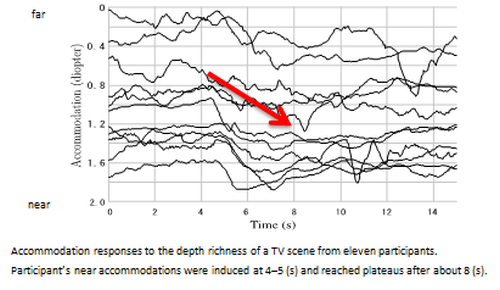
Conversely, undesirable effects are that a person watching 3D images or a shaky image may experience eye fatigue or a motion sickness. To clarify what can be done to minimize these undesirable effects, we are studying the relationship between the undesirable effects and presented images by subjective evaluations and biometric measurements. In this process, we measure eye movements, autonomic nervous system, and brain activity to quantify the degree of the undesirable effects. Based on these results, we have proposed measures to prevent and mitigate undesirable biological effects.
- Desired cooperation
-
- Quantification of quantities that are difficult to measure with measuring instruments
- The relationship between imaging systems and human
- Points to keep in mind when creating 3D videos, etc.