-
Faculty of Engineering, Department of Architecture
- Associate professor
- Daiu MABUCHI
- Research Field
Architectural Planning, Architectural Design Methodology, Architectural Design
- Keyword(s)
Virtual Reality, Measurement by Psychology and Physiology, Subject Experiment
- Research theme
-
- Exploring techniques for creators and users to co-create
- Method Development to reflect users' viewpoints to creation based on their stress index
- Exploring a design methodology using virtual reality and algorithm design
Outline of research activities

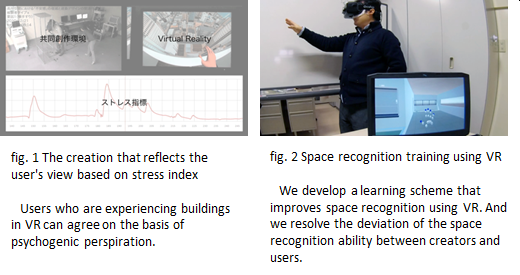
The way of manufacturing is undergoing major changes. One of the changes is co-creation. Development of a new manufacturing method beyond the gap between the creator and the user is a big challenge.
In my laboratory, I am studying a method to eliminate the barriers between creators and users as much as possible using Stress Index, Virtual Reality and so on. And we aim to construct a place where co-creation is possible.
- Desired cooperation
-
- Practice of manufacturing using stress index and VR
- Joint development of interior and exterior design
- The architectural design of small scale building
-
Faculty of Engineering, Department of Architecture
- Lecturer
- Michisato IKEDA
- Research Field
Architectural Design, Architectural Theory, Architectural Spatial Theory, Studies of Architects
- Keyword(s)
Space Design, Community Development, the Islamic world, Venetian Architecture, 3D Scanning, Photogrammetry
- Research theme
-
- Spatial Design and Preservation/Use through 3D Surveying of Historic Architecture
- Community Development in Collaboration With Industry, Government, Academia, and Local Communities
- Practical Research Through Architectural Design, Urban Design and Product Design
Outline of research activities

Using 3D scanners and photogrammetry, I conduct research on spatial design, preservation and utilization of architectural works designed by Le Corbusier and Kiyonori Kikutake, as well as cultural heritage sites in the Islamic regions such as Jordan.
My research also focuses on understanding the current state of cultural heritage/architecture as “living heritage,” as well as methods for their preservation and utilization.
Additionally, I am conducting practice-based research on community planning/development in collaboration with local governments and researching on Italian cities and architecture, with a particular focus on Venice.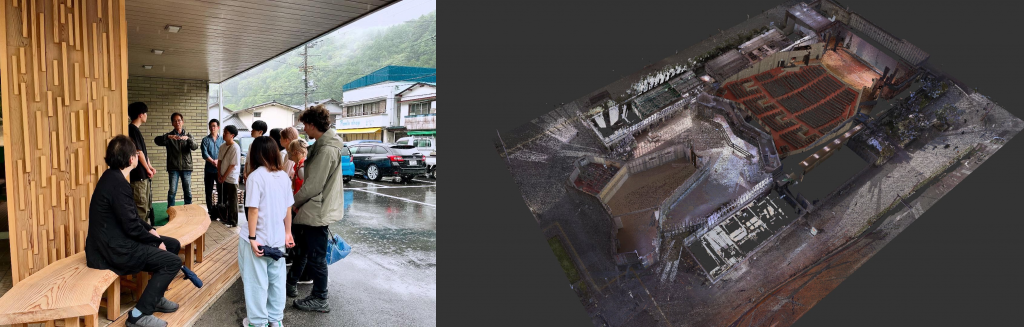
- Desired cooperation
-
- 3D Surveying and Research on Methods for the Preservation and Utilization of Cultural/Architectural Heritage
- Community Development and Design in Collaboration With Industry, Government, Academia, and Local Communities
- Collaborative Research and Production in Architecture, Urban Design, and Product Design
-
Faculty of Information Science and Engineering, Department of Information Science and Engineering
- Professor
- Kazunori OYAMA
- Research Field
game engineering
- Keyword(s)
Game programming, Social contribution through games
- Research theme
-
- Real-time rendering
- Behavioral changes brought about by games, etc.
Outline of research activities
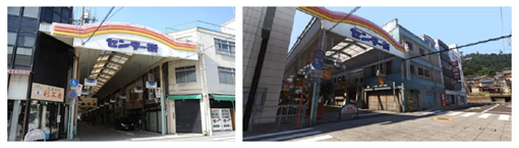
Computer games have grown along with technology, incorporating various cutting-edge technologies. Among them, our research focuses on real-time rendering technology that supports interactivity and immersion, and networks that support connections with others. Through research on the mechanisms of getting hooked on games and social media, I would like to work on social contribution through games (education, community revitalization, aesthetics, public relations, etc.) and the role that games play in society.
- Desired cooperation
-
- Programming education, support for local information education
- Games and monitoring systems for the elderly
- Community revitalization, aesthetics, public relations, etc. through games
-
Faculty of Information Science and Engineering, Department of Information Science and Engineering
- Professor
- Masaki EMOTO
- Research Field
Image information enginnering, Human Factor, Vision Science
- Keyword(s)
Imaging System、Vision、Stereopsis、Autonomic Nervous
- Research theme
-
- Imaging system and human vision
- Effects of imaging system on human
- Kansei enginnering
Outline of research activities
We are interested in the effects of the artificial environment of imaging systems on humans. We have studied both pros and cons effects. Examples of the good effects are viewers’ sense of power, immersion, and presence, in which the viewers feel as if they are in the space projected by the imaging system. The problem of quantifying these senses is that it is not possible to measure them with a measuring instrument. These characteristics related to human senses and sensitivity can quantified through subjective evaluations and questionnaires. At the same time, biometric measurements are performed to search for measurement items that may serve as biological indices. We are investigating the relationship between subjective evaluations and biological indices.
Conversely, undesirable effects are that a person watching 3D images or a shaky image may experience eye fatigue or a motion sickness. To clarify what can be done to minimize these undesirable effects, we are studying the relationship between the undesirable effects and presented images by subjective evaluations and biometric measurements. In this process, we measure eye movements, autonomic nervous system, and brain activity to quantify the degree of the undesirable effects. Based on these results, we have proposed measures to prevent and mitigate undesirable biological effects.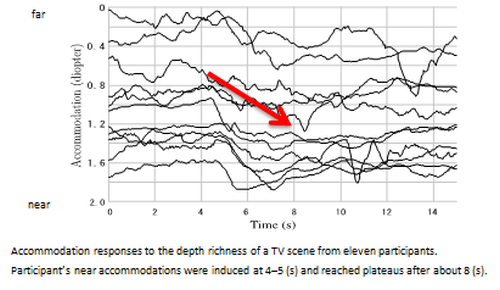
- Desired cooperation
-
- Quantification of quantities that are difficult to measure with measuring instruments
- The relationship between imaging systems and human
- Points to keep in mind when creating 3D videos, etc.
-
Faculty of Information Science and Engineering, Department of Information Science and Engineering
- Professor
- Michio SAKAKIHARA
- Research Field
Numerical scientific computation,
- Keyword(s)
Discretization method, Mathematical modelling, Optimization method
- Research theme
-
- Alternative least sqear method,
- Simple function evaluation for embedded software
- Extending the concept of differentiation to develop
- optimization methods for more complex targets.
Outline of research activities
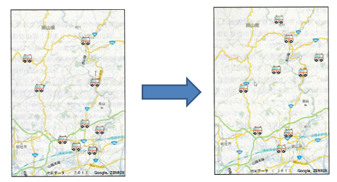
There are many application fields for the development of rational methods for inferring desired information from observed data. One of the techniques is the alternating least squares method for decomposing a matrix. This method is used in a wide range of fields from analysis of psychological data to image processing. However, the theoretical background of this approach does not seem to be fully clarified. I am conducting research with various interests, centering on research to clarify the theoretical background of the alternating least squares method.
- Desired cooperation
-
- General problems for which no mathematical model has been established.
-
Faculty of Information Science and Engineering, Department of Information Science and Engineering
- Professor
- Shinji MIYAKE
- Research Field
Learning support system, Software engineering
- Keyword(s)
Learning support system, Understanding, Awareness
- Research theme
-
- Learning support system for algorithms and programming
Outline of research activities

Even if you think you understand it, if you look at it from a different perspective, you may find some unclear points.
We are researching the construction of an easy-to-understand learning system that makes difficult-to-understand teaching materials easier to handle, encourages confirmation from multiple perspectives, and is easy to understand.
Based on conventional CAI and e-learning methods, we aim to build and release learning support systems such as algorithms and programming.
We are also researching a system that presents answers to simple puzzles in order to cultivate logical thinking.- Desired cooperation
-
- Algorithm, programming education support
-
Faculty of Information Science and Engineering, Department of Information Science and Engineering
- Professor
- Tetsuya AKAGI
- Research Field
Mechatronics, Pneumatic control device, Mechanical control
- Keyword(s)
Soft actuator, Wearable control system, Embedded controller
- Research theme
-
- Development of Low-cost Flexible Pneumatic Actuator and Its Application for Home-based Rehabilitation Devices
- Development of Low-cost Wearable Fluid Control Valve and Its Application
- Development of Various Flexible Robots Using Flexible Pneumatic Actuators
Outline of research activities


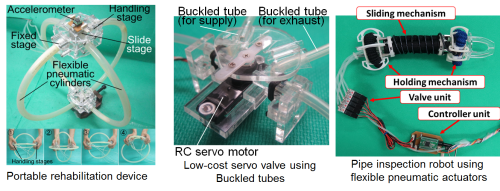
By taking advantage of pneumatic actuators that have features of higher force / mass ratio, lightweight and flexibility based on compressibility, we have developed low-cost wearable actuators and low-cost home-based rehabilitation devices that can be disposable after using it. Specifically, we developed a flexible pneumatic cylinder that can be used even if the cylinder bends. A spherical actuator that consists of two flexible pneumatic cylinders have been also developed as an application for portable rehabilitation device. We have also developed a low-cost wearable servo valve using buckled tubes, an artificial muscle with built-in displacement sensor and a pipe inspection robot using extension type flexible pneumatic actuators. In addition, aiming at globalization for students, all graduate students in our laboratory have presentation in international conferences.
- Desired cooperation
-
- Development of wearable pneumatic controlled devices using embedded controllers and its application
- Implementation of low-cost, small-sized and light-weight pneumatic control valves
- Development and application for flexible actuator and flexible sensors
-
Faculty of Information Science and Engineering, Department of Information Science and Engineering
- Professor
- Tokumi YOKOHIRA
- Research Field
Information Networks
- Keyword(s)
Communication Protocols, Network Securities
- Research theme
-
- Highly Distributed Cloud Environments
- High-Speed Internet Technologies
- Fault-Tolerant Internet Technologies
Outline of research activities
I have been engaged in research aimed at enhancing the functionality of computer networks. My specific research areas are as follows:
Highly Distributed Cloud Environments: In the context of edge computing, I am studying server placement strategies that can reduce response latency while ensuring the delivery of accurate and context-aware responses.
High-Speed Internet Technologies: I am working on methods to mitigate throughput collapse (called TCP Incast) within Data Center Networks (DCN) that employ TCP (Transmission Control Protocol) as their transport protocol.
Fault-Tolerant Internet Technologies:
I am researching techniques to ensure communication continuity by enabling rapid rerouting to bypass network failures as soon as they occur.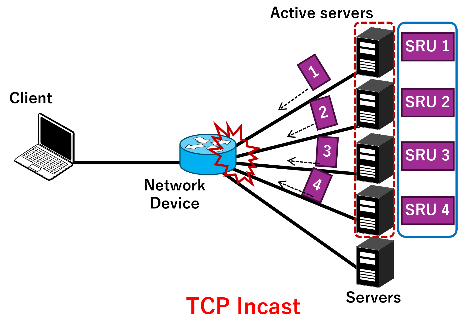
- Desired cooperation
-
- Research on Information Networks
- Research on Communication Protocols
- IoT (Internet of Things) System Architecture and Implementation
-
Faculty of Information Science and Engineering, Department of Information Science and Engineering
- Professor
- Toshiyuki KOHNO
- Research Field
Numerical Analysis / Utilization of ICT in Education
- Keyword(s)
Linear system, Preoconditioning, Iterative method / ICT
- Research theme
-
- Improvements in the linear iterative algorithm
- Parallel iterative method for large sparse linear equation
- Improvement of distance learning using ICT
Outline of research activities
(Numerical analysis)In scientific computing most computational time is spent in solving systems of linear equations. It is necessary to study an algorithm for solving the large linear system fast and stably. We have proposed several new iterative algorithms and preconditioning techniques.
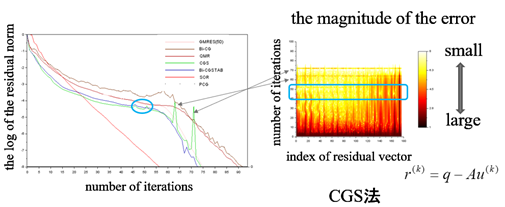
Vertical axis is the number of iterations, horizontal axis is the index of residual vector, and we display the magnitude of the residual vector in the color. When this becomes black beyond the red, the error becomes large and when this becomes white beyond the yellow, the error becomes small.
(ICT)Distance learning is a way of learning remotely without being in regular face-to-face contact with a teacher in the classroom. We study the support system for the programming lecture in distance learning.- Desired cooperation
-
- Approach to solving the large linear system.
- Improvement of education with using ICT
-
Faculty of Life Science, Department of Medical Technology
- Professor
- Junya HORI
- Research Field
Clinical Engineering, Safety Management of Electro-Medical Equipment, Medical Education
- Keyword(s)
Defibrillator AED, electrocautery, blood purification therapy, Basic Life Support
- Research theme
-
- Safety evaluation of high-energy devices such as defibrillators and electrocautery
- Development of various sensors for blood purification
- Development of various educational tools for medical education
Outline of research activities
(1) Many medical devices that use electricity, such as defibrillators, AEDs, and electrocautery, are used in the medical field. If these devices are not used properly, they can cause electric shocks and burns. In this study, we investigate the electrical hazards associated with improper use of these devices.
(2) It is important to obtain information on patients noninvasively in blood purification therapy. We are developing and improving sensors such as urea sensor using chemiluminescence.
(3) In training clinical engineering technicians, it is necessary to provide various practical training, but it is not possible to use actual patients. Therefore, we are developing educational materials for practical training that can be used in place of living bodies. We are also developing educational tools that can be used in primary life saving seminars for the general public.

- Desired cooperation
-
- Development of safety evaluation devices for medical electrical equipments
- Development of educational devices for medical education
-
Faculty of Biosphere Geosphere Science, Department of Biosphere Geosphere Science
- Professor
- Hiroyuki IKETANI
- Research Field
Taxonomy of cultivated plants, Horticulture
- Keyword(s)
Tree, Population Genetics, Cultivar
- Research theme
-
- Hybridization between wild and cultivated plants
- Population genetics of wild plants escaped from cultivation
- Genotyping of cultivars
- Nomenclature of cultivated plants
Outline of research activities
I study hybridization and introgression of wild and cultivated plants using molecular markers. Especially I analyze those the distinction of which from native plants are now difficult due to their naturalizaion in pre-modern times. I also study the distinction and origin of cultivars using molecular genotying. In addition, I study the problems in denomination and nomenclature of cultivated plants as a member of the Internationl Commission for the Nomenclature of Cultivated Plants.
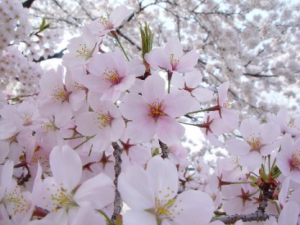
Infrorescence of a tree cultivated as ‘Somei-yoshino’ at the Koshikawa Botanical Gardens, University of Tokyo. I demonstrated that this individual has different genotype from true ‘Somei-yoshino’, the clonallity of the latter cultivar is verified by molecular markers.- Desired cooperation
-
- Collection and investigation of crops and cultivated plants
- Conservation and management of wild genetic resources
- Development and utilization of traditional and/or novel crops and cultivated plants
-
Faculty of Biosphere Geosphere Science, Department of Biosphere Geosphere Science
- Professor
- Keiji NAKAMURA
- Research Field
Biology
- Keyword(s)
Insect, Life history, Seasonal adaptations
- Research theme
-
- Experimental analysis of insect life-cycle adaptations
- Analysis of environmental factors affecting animal life cycles
- Studies of of environmental effects on amphibian growth and development
Outline of research activities

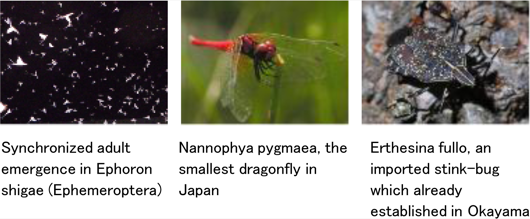
Insects adapt to various terrestrial environments. In temperate regions, to survive cold temperatures in winter is essential for insects. Thus, many insects predict the arrival of period which is not suitable for development and reproduction, and change their physiological state. I am studying how insects regulate the life cycles in response to environmental signals, by field observations and rearing experiments.
- Desired cooperation
-
- Preservation of ecosystems
- Experimental analysis of pest's life cycle
- Effects of environmental changes on animal ecology
-
Faculty of Biosphere Geosphere Science, Department of Biosphere Geosphere Science
- Professor
- Mitsuhiko HONDA
- Research Field
Observational Astronomy, Planet Formation
- Keyword(s)
Protoplanetary disk, Instrument development
- Research theme
-
- Observation of protoplanetary disk
- Observation of Solar system minor bodies (comets)
- Development of new astronomical instrument and method
Outline of research activities

How the earth and planets are formed ?
I’m trying to answer this question by observing protoplanetary disks, which is the on-going planet forming site around young stars. Current large telescopes such as Subaru telescope allow us to reaveal the detailed signature of the planet formation process in the protoplanetary disks.
In addition, I’m also involved with the new development of the astronomical instrument and methed.
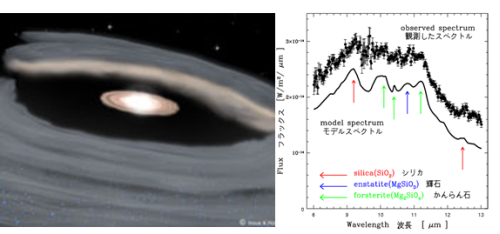
(Left) Artist’s illustration of the protoplanetary disk around HD142527 star
(Right) Detection of olivine and pyroxene crystals around Hen3-600A star- Desired cooperation
-
- Research on planet formation
- Research on Solar system minor bodies
- Development of new astronomical instrument and method
-
Faculty of Biosphere Geosphere Science, Department of Biosphere Geosphere Science
- Professor
- Tomohiro TAKEYAMA
- Research Field
Animal Ecology, Behavioral Ecology, Community Ecology
- Keyword(s)
Ecosystem, Biodiversity, Aquatic organism
- Research theme
-
- Behavioral Ecology in fish
- Food-web and Biodiversity in aquatic ecosystem
- Landscape Ecology and Landscape Genetics
Outline of research activities
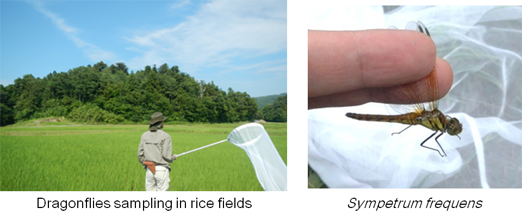
I have interests in parental care and sexual conflicts over reproduction in teleost fishes. My goal is to understand social relationship among individuals by approaching the field researches and observations in lab conditions, from evorutionary views. In the resent years, I also conduct some field works to examine a composition of food-webs in aquatic ecosystem and evaluate the relationships between biodiversity of aquatic animals (e.g. dragonflies) and their local and landscape habitats.
- Desired cooperation
-
- Ecology and behavior in fish
- Evaluation and monitoring of biodiversity in aquatic ecosystem
- Reconstruction and conservation of aquatic ecosystem
-
Faculty of Biosphere Geosphere Science, Department of Biosphere Geosphere Science
- Associate professor
- Hiroko UDAKA
- Research Field
Biology, Animal Physiology
- Keyword(s)
Life cycle, insects, slugs, distribution
- Research theme
-
- Seasonal adaptation in insects and slugs
- Cold tolerance in insects and slugs
- Citizen science
Outline of research activities
I am interested in the mechanisms of seasonal adaptation in insects and slugs. Through field collection and laboratory rearing, my research investigates how factors like photoperiod and temperature influence life history traits, their geographic variation, and the physiological mechanisms of cold tolerance. In recent years, I have also been involved in citizen science (project science) initiatives, including surveys on the distribution of newly introduced slug species.
- Desired cooperation
-
- Research on life history and thermal tolerance in insects
- Ecological and taxonomic studies of slug species
-
Faculty of Biosphere Geosphere Science, Department of Dinosaur Paleontology
- Professor
- Masato FUJITA
- Research Field
Geology, Sedimentology, Plaleontology, Museology
- Keyword(s)
Paleoenvironment, Geological survey, footprint, Museum, Exhibition
- Research theme
-
- Geology, Sedimentology, and Paleontology of the Mesozoic system
- Paleoecology of dinosaurs on the basis of footprints
- Effective museum exhibition techniques
Outline of research activities
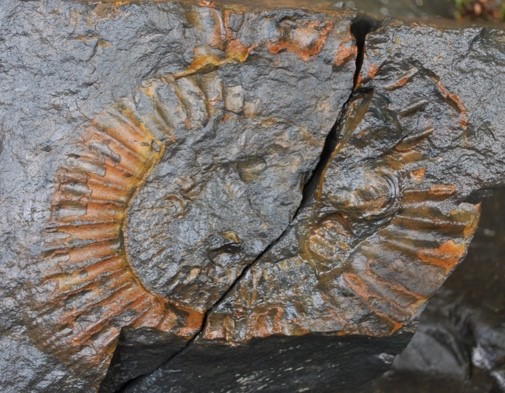
Through field-based surveys, I am conducting research to clarify the geology and paleoenvironment of Mesozoic strata distributed in the Hokuriku region. I am also conducting research to clarify ecology of dinosaurs, such as their gait, walking speed, and gregarious behavior, based on dinosaur footprints. We will also be researching effective methods for museum exhibitions that focus on dinosaur fossils.
- Desired cooperation
-
- Research on the protection of fossils exposed in the wild, such as footprint fossils
- Effective museum exhibit techniques using digital technology
-
Faculty of Biosphere Geosphere Science, Department of Dinosaur Paleontology
- Professor
- Mototaka SANEYOSHI
- Research Field
Geology, Sedimentology, Paleontology
- Keyword(s)
Paleoenvironments, Geological survey, Fossil Taphonomy
- Research theme
-
- Stratigraphy of Upper Cretaceous of Gobi desert, Mongolia
- Late Cretaceous of Dinosaur fossils from Gobi desert, Mongolia and Late Miocene Mammalian fossils from Great Rift Valley in Kenya
- Sedimentation processes of modern River systems
- Paleoenvironments of Miocene sediments in Nagi, Okayama Prefecture
Outline of research activities
I am actively involved in paleontological excavations spanning Mongolia, Kenya, and northern Okayama Prefecture, while simultaneously conducting meticulous paleoenvironmental reconstructions based on robust geological investigations. Moreover, my endeavors extend to the comprehensive reconstruction of the entire ecological framework of the relevant time periods, encompassing small vertebrates, insects, and invertebrates, achieved through the discernment of the intricate interconnections between fossils and their corresponding stratigraphic contexts. Furthermore, our team enthusiastically engages in lifelong learning endeavors, exemplified by organizing exhibitions, workshops, and lectures that showcase esteemed fossil specimens.

- Desired cooperation
-
- -
-
Faculty of Biosphere Geosphere Science, Department of Dinosaur Paleontology
- Professor
- Takafumi KATO
- Research Field
Vertebrate Paleontology, Phylogeny
- Keyword(s)
Mammal, Rodent, Paleogene, Neogene
- Research theme
-
- Evolution and adaptive radiation of terrestrial mammals
- in East Asia
- Research on Mesozoic marine reptiles
Outline of research activities
In Japan, fossils of small mammals, such as those the size of mice or moles, are rarely found in older geological strata. This scarcity is largely due to the fact that fossil searches for small mammals have primarily focused on sediments accumulated in limestone fissures or caves, which are uncommon in strata older than 800,000 years. As a result, discoveries of small mammals from these earlier periods have been limited. Using new methods, I have successfully extracted small mammal fossils from strata dating back 3.5 million and 26 million years. My work contributes new insights into Japan’s fossil mammal record, which has traditionally been dominated by reports of large mammals such as elephants and deer, and aims to shed light on transitions in mammalian fauna across East Asia.

- Desired cooperation
-
- Research related to paleovertebrates
- Research on extraction methods for small vertebrate
- fossils
-
Faculty of Biosphere Geosphere Science, Department of Dinosaur Paleontology
- Associate professor
- Shoji HAYASHI
- Research Field
Vertebrate Paleontology, Bone Histology, Evolutionary Biology
- Keyword(s)
Dinosaur, Mammal, Bone Histology, Aquatic Adaptation, Ontogeny
- Research theme
-
- Dinosaur Paleobiology
- Secondary adaptation of tetrapods to life in water
- Gigantism and dwarfism of vertebrates
Outline of research activities
Bone histology is the study of bone function and growth by sectioning bones into thin slices to visualize internal tissues. This technique has proven instrumental in uncovering the physiology and ecology of extinct animals, providing insights into their growth rate, age, metabolism, and degree of aquatic adaptation — factors that were previously challenging to reconstruct. My research focuses on employing bone histology to explore the life and adaptive processes of large vertebrates, such as dinosaurs and mammals. Specifically, I aim to uncover what factors influenced these creatures to evolve into giants or diminutive forms and how terrestrial vertebrates altered their physiology and bone structure to successfully readapt to aquatic environments.

- Desired cooperation
-
- Researches on living vertebrates (e.g., ecology, anatomy, and pathology)
- Paleoenvironment researches based on geology
- Vertebrate paleontological researches
-
Faculty of Education, Department of Primary Education
- Professor
- Junko SAITO
- Research Field
Art education
- Keyword(s)
Skill for expressive arts, Art apuureciation, Development of teaching materials
- Research theme
-
- Development of teaching materials and instructional methods for acq
- Development of teaching materials to foster diverse views and ways of thinking
- Methods of teaching appreciation to enhance expressive ability
- Development of color teaching methods (traditional Japanese colors, etc.)
Outline of research activities
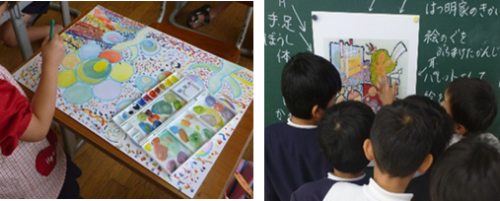
My research is a practical study based on the reality of children’s thinking and expression as seen from the school site. Arts and crafts is a subject that deepens awareness of diversity. I will develop teaching materials that aim to foster diverse ways of seeing and thinking and the acquisition of expressive skills. I will propose teaching methods that aim to improve children’s ability to think and create figuratively through learning from each other.
- Desired cooperation
-
- Research on arts and crafts classes at schools
- Art Appreciation Education with Museums
Search by department
Search by SDGs