-
Faculty of Veterinary Medicine, Department of Veterinary Medicine
- Assistant professor
- Takeshi HOMMA
- Research Field
Veterinary anatomy, Comparative anatomy
- Keyword(s)
Inner ear, Vertebrates, Neurotrophic factor
- Research theme
-
- Comparative anatomical study of Vertebrate's inner ear
- Histochemical study of mammal's auditory organ
Outline of research activities

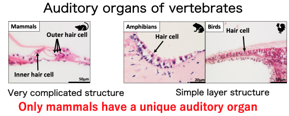
In mammals, auditory organ is composed of two types of hair cells, inner and outer hair cells, and various supporting cells. In contrast to the clear anatomical diversity of hair cells and supporting cells in mammals, the auditory organs of non-mammals show a simple structure in which hair cells and supporting cells are arranged in a row. I’m studying the evolution of the mammalian auditory system from a comparative anatomical perspective. In addition, I’m studying the molecules that are expressed characteristically in various types of supporting cells in order to elucidate the roles of each type of supporting cell in mammals.
- Desired cooperation
-
- In situ hybridization
- Study of the auditory system of vertebrates
-
Faculty of Veterinary Medicine, Department of Veterinary Medicine
- Assistant professor
- Takuya KANDA
- Research Field
Food safety and Food Microbiology, Bacteriology, Animal Health
- Keyword(s)
Mycoplasma bovis, adhesion, Loop-mediated isothermal amplification, HACCP
- Research theme
-
- The factor of Mycoplasma bovis adhesion in infection
- The rapid detection of bacteria
- Assessment of microbial contamination risk in meat products
Outline of research activities


Food hygiene is expected to more important due to HACCP and export of meat and marine product.
Pneumonia is a common disease in feedlot, and Mycoplasma bovis may be involved. The bacteria occur such as pneumonia, mastitis, and arthritis. Endocarditis, which causes lesions in the heart, is occasionally observed at slaughterhouses (Fig). The researches of adhesive factors for vaccine development leads to a stable supply of meat product.
Enterohemorrhagic Escherichia coli (EHEC, STEC), Salmonella, Campylobacter,which are known to be food poisoning, are tested at the Meat Inspection Center. The study of food microbiology that have attracted attention in recent years, such as Clostridium perfringens and Listeria monocytogenes, makes to improve food safety.

- Desired cooperation
-
- Resareches on adhesion of Bacteria to host cell
- The rapid detection of bacteria using LAMP and PCR etc...
-
Faculty of Veterinary Medicine, Department of Veterinary Associated Science
- Associate professor
- Sachi OKABAYASHI
- Research Field
Primate Medical Science, Veterinary Pathology, Postoperative Care of Animals
- Keyword(s)
Pathological analysis of primates, Chronic pain, Enrichment
- Research theme
-
- Pathological analysis of spontaneous diseases in primates
- Methods for the assessment and treatment of chronic pain and visceral pain
- Environmental enrichment for experimental animals or zoo animals
Outline of research activities
Non-human primates are prone to a variety of naturally occurring diseases, including diabetes, hyperlipidemia, heart disease, endometriosis, gastrointestinal disorders such as gastric dilatation and intractable diarrhea, macular degeneration, cataracts, periodontal disease, growth disorders, and tumors. We are conducting research to clinically and pathologically evaluate these conditions and assess their potential as models for human diseases.
Furthermore, chronic pain, such as neuropathic pain, can persist even after damage to the nervous system has healed, resulting in ongoing pain and discomfort. However, many aspects of its causes remain unclear. We conduct research on the assessment and treatment of chronic pain and visceral pain, with the aim of contributing to pain management in both animals and humans.
When I actually tried using toys to care for experimental animals, the animals often lost interest quickly and stopped playing, broke the toys, or left them in unsanitary conditions, which frequently led me to question their effectiveness. I am eager to actively engage in research on environmental enrichment for animals.- Desired cooperation
-
- Research on disease models using primates
- Chronic pain and visceral pain
- Environmental enrichment for animals
-
Faculty of Veterinary Medicine, Department of Veterinary Associated Science
- Associate professor
- Satoru AKASE
- Research Field
Microbiology, Food Hygiene, Zoonotic Infectious Diseases
- Keyword(s)
Campylobacter, Foodpoisoning, Food Safety, Game Meat (Gibier), Raw chicken sashimi (Torisashi)
- Research theme
-
- Studies on Campylobacter food poisoning associated with poultry meat
- Studies on typing methods for Campylobacter
- Research on risk communication related to the consumption of raw or undercooked meat
- Research on wildlife management in Ehime Prefecture (wild boar, deer, etc.)
Outline of research activities
(Research on Campylobacter Control in Poultry Meat)
This study examines hygiene management for raw poultry dishes such as torisashi and tori-tataki, aiming to reduce Campylobacter food poisoning associated with undercooked chicken.
(Research on Campylobacter Typing Methods)
The project focuses on developing rapid typing techniques using bacterial genes, proteins, and other markers to support quick identification during outbreaks.
(Research on Risk Communication for Raw Meat Consumption)
This research explores effective ways to communicate foodborne illness risks related to raw meat products such as basashi, yukhoe, and raw liver, seeking new communication approaches beyond traditional one-way messaging.
(Research on Wildlife Management in Ehime Prefecture)
This study contributes to addressing agricultural damage and ecological disruption caused by wild boar, sika deer, and macaques through scientific analysis and collaboration among industry, government, academia, and financial sectors.- Desired cooperation
-
- Research on scheduled slaughter in poultry farms and poultry processing facilities
- Research on hygiene management and market development for game meat processing facilities
- Requests for lectures and workshops on public risk communication about food safety
-
Organization for Research and Community Collaboration, Research and Community Collaboration Center
- Specially appointed professor
- Masachika TSUJI
- Research Field
Road Ecology
- Keyword(s)
Roadkill,Railkill
- Research theme
-
- Research on using low and high frequencies to keep wildlife and humans at a distance
- Roadkill Countermeasures
- Bird strike countermeasures
Outline of research activities
We are conducting research to return the relationship between both animals and humans to a more natural state by using low and high frequencies to deter roadkill and railkill as well as beast damage control. The low-frequency “InoDon kumaDon” uses sensors to drive away wild boars, bears, etc. trapped there, and the high-frequency “Hyper Deer Sonic” uses a timer to run for a certain time and is used on deer, birds, etc., with great results. There is no effect on other animals or humans. The high-frequency type is available in vehicle-mounted and installed types, while the low-frequency type is only available in the installed type due to the large diameter of the speaker. However, a portable type, Hyper Deer Sonic, is currently under development and is highly anticipated by people in the forestry and mountaineering industries.

- Desired cooperation
-
- No sound habituation reset due to bear hibernation
- study of animal behavior
-
Organization for Research and Community Collaboration, The Institute of Viticulture and Enology
- Professor
- Akihiro KANEKO
- Research Field
Brewing , Applied Microbiology, Functional food
- Keyword(s)
Wine, Yeast, Brewing, Functional food
- Research theme
-
- Research into alcoholic beverages.
- Beneficial effects of wine polyphenols.
Outline of research activities



We aim to contribute to the development of the wine industries and education, through our research.
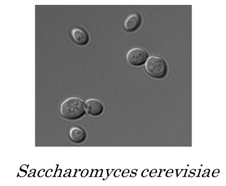
Research and invstigation into wine, Japanese sake, fruits and functional foods. Invesigation of volatile compaounds in wine and its produvtion mechanisms. Especially, advanced analysis and evaluation of wine.Wine has favorable and characteristic flavor. We indentify the characteristic compounds in wine and investigate their production mechanisms.
Wine have multiple health functionalities since it is a fermented material. We investigate the health functionality of wine and fermented foods in vitro.And, we investigate the health functinalities of functinal components fermented foods.
- Desired cooperation
-
- Brewing , Microbiology
-
Organization for Research and Community Collaboration, Biomedical Science Examination and Research Center
- Associate professor
- Akihisa HATA
- Research Field
Medical technology, Environmental hygiene
- Keyword(s)
Antimicrobial resistance, Enterobacteria, Arsenic, Analytical technique
- Research theme
-
- human and animal clinical testing technologies
- Research on antimicrobial resistance bacteria based on the One Health Concept
- food safety and functionality
Outline of research activities

We not only analyze the health status of humans, animals, the environment, and food, but also develop new testing methods to evaluate them.
In recent years, we have been conducting joint research with local governments and companies to develop processing methods to reduce food loss and add value to food ingredients, to evaluate the pharmacokinetics of functional ingredients in foods, and to develop new testing methods for inflammation markers.- Desired cooperation
-
- blood test
- bacteriological test
- food testing
Search by department
Search by SDGs