-
Faculty of Life Science, Department of Bioscience
- Associate professor
- Atsuhito KUBOKI
- Research Field
Synthetic organic Chemistry, Bioorganic chemistry
- Keyword(s)
Organic reaction, Enzymatic reaction, Bioactive compound
- Research theme
-
- Development of Development of new synthetic methodologies of ο-quinones
- Studies on chemo-enzymatic processes for fine chemicals
Outline of research activities


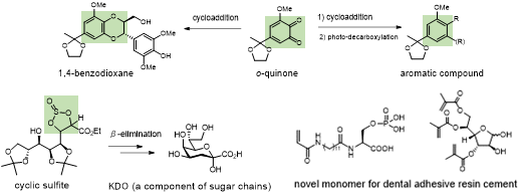
Our group is interested in developing new synthetic methodologies to enable synthesis of biologically active natural compounds and their derivatives in environmental friendly manner. As such manners, we have developed metal-free regioselective cycloaddition of highly reactive o-quinone to form 1,4-benzodioxane and a procedure for construction of benzene ring from o-quinone and terminal alkynes through cycloaddition and photo-decarboxylation. We have also reported concise synthetic route to KDO, a kind of carbohydrate, including elimination of cyclic sulfite as a key step. By collaborative research with a company, functional monomers for dental adhesive resin cements have been developed.
- Desired cooperation
-
- Development of fine chemicals by analogue synthesis
- Partial modification of lead compound
-
Faculty of Life Science, Department of Bioscience
- Associate professor
- Midori FUTAMI
- Research Field
Protein engineering
- Keyword(s)
Protein chemistry, Funactional regulation of mammalian cells, Blood purification
- Research theme
-
- Artificial regulation of mammalian cells by protein transduction technology.
- Development of plasma adsorption column using protein ligand.
Outline of research activities
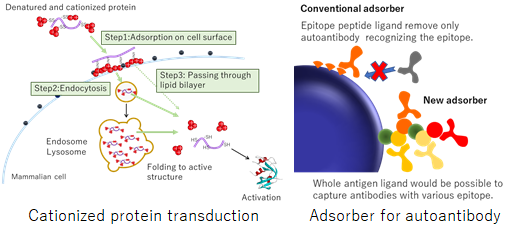
Denatired protein forms insoluble aggrigate. Chemical cationization of decatured protein s them water soluble. Based on this protein cationization method, we have studied two theme as described later. Left panel shows the outline of cationized protein transduction for living mammalian cells。Cationized protein efficiently adosorbed to negatively charged cell surface and uptaked by endocytosis. Right panel shows application of cationized protein for adosorbent of autoantibody. Denatured and cationized whole antigen immobilized on adsorber would be possible to capture antibodies with various epitope.
- Desired cooperation
-
- Production of recombinant protein by the host of E.coli or mammalian cell.
- Protein analysis.
- Mammalian cell regulation.
- Development of plasma adsorption column using protein ligand.
-
Faculty of Life Science, Department of Medical Technology
- Professor
- Ken KATAOKA
- Research Field
Cell Biology, Regenerative Medicine
- Keyword(s)
Cell Culture, 3D culture, Spheroids
- Research theme
-
- 3D culture of tissue stem cells
- Artificial control of spheroid formation
- Assessment system of cell culture techniques
Outline of research activities
Epithelial cells in spheroids formed through three-dimensional culture exhibit a quiescent state. Our research aims artificial interventions to control cell proliferation and differentiation during spheroid formation. Additionally, aiming for the standardization of cell culture techniques, we are advancing the development of a assessment system utilizing recorded videos.

- Desired cooperation
-
- Assessment system of cell culture techniques
-
Faculty of Life Science, Department of Medical Technology
- Professor
- Takayoshi KIBA
- Research Field
Gastroenterology, Oncology
- Keyword(s)
Visceral organs, Regeneration, Proliferation, Carcinogenesis
- Research theme
-
- Identification of new nerve-delivered growth factor regarding pancreatic B cells.
Outline of research activities
We found that vagal hyperactivity produced by ventromedial hypothalamic (VMH) lesions stimulated cell proliferation of rat pancreatic islet B through a cholinergic receptor mechanism. Previously, we developed a new technique regarding high-quality RNA extraction from rat pancreas for cDNA microarray analysis, and thereby, we found that VMH lesions may change the expression of cell proliferation-related genes and neuron-related genes in a rat pancreas, using DNA microarray and real-time polymerase chain reaction. We believes that these new gene network analysis will lead to Diabetes MellitusTreatment or Pancreatic Cancer.

- Desired cooperation
-
- R & D regarding regeneration and proliferation of pancreatic B cells
-
Faculty of Life Science, Department of Medical Technology
- Associate professor
- Daiki OUSAKA
- Research Field
Pharmacology, Cardiovascular Surgery, Biomedical Information Science
- Keyword(s)
Genome Editing, Zebrafish, Blood Products, Data Science, Diamond-like Carbon
- Research theme
-
- Drug discovery and disease target molecule identification using a combination of Data Science × Genome Editing (CRISPR) × Zebrafish
- Development of biosensors for real-time sensing of biomolecules in vivo
- Development of medical coatings utilizing carbon-based thin films
- Technology development for ensuring the health and safety of agricultural workers
Outline of research activities
・Drug Discovery and Target Identification
Human plasma contains over 3,000 proteins, yet less than 20 are used in current blood products. To discover novel therapeutic candidates, we integrate Data Science, CRISPR-based genome editing, and zebrafish models—focusing on neurological diseases and congenital heart defects.・Medical Coating Development
Medical devices such as catheters and artificial blood vessels require high biocompatibility and antimicrobial properties. We are developing novel coatings using patented Diamond-like Carbon (DLC) technology, aiming for improved safety, tissue regeneration, and real-time biosensing functionality.・Health and Safety in Agriculture
Agricultural workers face a significantly higher risk of fatal accidents. Our work focuses on long-term health monitoring and accident prevention, using data-driven approaches and bio-design strategies in collaboration with industry, academia, and government.- Desired cooperation
-
- Life science research utilizing zebrafish
- Development of biosensors for real-time sensing of biomolecules in vivo
- Technology development to support health and safety management of agricultural workers (e.g., systems for heatstroke prevention, accident mitigation, and behavior modification)
-
Faculty of Life Science, Department of Medical Technology
- Lecturer
- Yoshie ASAHARA
- Research Field
Medical welfare engineering, medical technology evaluation, biomedical engineering
- Keyword(s)
Clinical engineering, ventilatory therapy, sensors, mask fitting
- Research theme
-
- NPPV mask monitoring
- Basic experiments on oxygen cannula for oxygen therapy, etc.
Outline of research activities
We are developing “sensors that collect information” necessary for patients to receive treatment with peace of mind.
For example, a ventilator used by patients with lung diseases at home is an indispensable medical device. We are developing sensors based on our own ideas to provide patients with more secure treatment using such ventilators.- Desired cooperation
-
- Research on home respiratory therapy
- Research on evaluation of medical devices, etc.
-
Faculty of Biosphere Geosphere Science, Department of Biosphere Geosphere Science
- Professor
- Mitsuhiko HONDA
- Research Field
Observational Astronomy, Planet Formation
- Keyword(s)
Protoplanetary disk, Instrument development
- Research theme
-
- Observation of protoplanetary disk
- Observation of Solar system minor bodies (comets)
- Development of new astronomical instrument and method
Outline of research activities

How the earth and planets are formed ?
I’m trying to answer this question by observing protoplanetary disks, which is the on-going planet forming site around young stars. Current large telescopes such as Subaru telescope allow us to reaveal the detailed signature of the planet formation process in the protoplanetary disks.
In addition, I’m also involved with the new development of the astronomical instrument and methed.
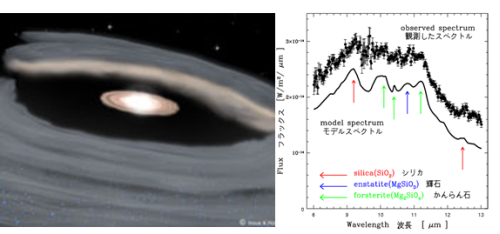
(Left) Artist’s illustration of the protoplanetary disk around HD142527 star
(Right) Detection of olivine and pyroxene crystals around Hen3-600A star- Desired cooperation
-
- Research on planet formation
- Research on Solar system minor bodies
- Development of new astronomical instrument and method
-
Faculty of Biosphere Geosphere Science, Department of Biosphere Geosphere Science
- Professor
- Takeharu SATO
- Research Field
Disaster prevention meteorology
- Keyword(s)
Sediment disaster, Rainfall
- Research theme
-
- Development of landslide disaster prediction technology
- Development of risk evaluation technology of landslide disaster
Outline of research activities

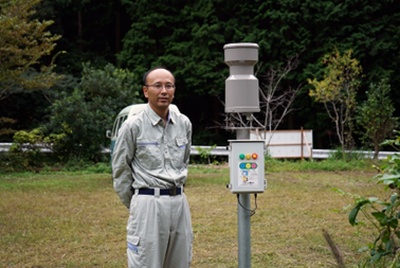
We have to evaluate the occurrence prediction and disaster occurrence risk of landslides from inspection data. We analyze the trend of the past of the disaster, to assess whether the “when” “where” landslide disaster occurs, we are working to hazard maps.
These results are considered useful in a safe life.
- Desired cooperation
-
- Construction consultant
- Disaster-prevention measures
-
Faculty of Biosphere Geosphere Science, Department of Biosphere Geosphere Science
- Professor
- Yousuke NOUMI
- Research Field
Geology,Geomorphology,Geoinformatics
- Keyword(s)
Granite,Rock Generation,Strata,Geomorphology,DEM,GIS
- Research theme
-
- Study on generation and emplacement of felsic magma such as granite
- Study on formation of strata and rocks distributed in Okayama Pref.
- Cultural geological study on various stone materials
Outline of research activities
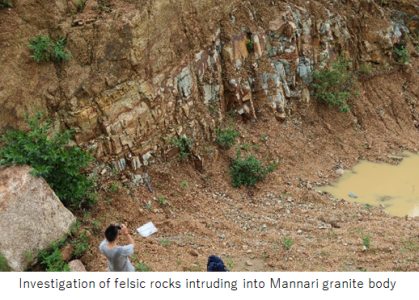
Our laboratory conducts petrological research on granites widely distributed in southwestern Japan, using fieldwork as the main means of study. In addition to granite, we also reserch to tuffs and basic igneous rocks. Informatics technics, such as GIS are used in study. In addition, granite weathering, landform formation, stone material utilization, etc. are being studied.
- Desired cooperation
-
- Investigation and research on geology and topography in Okayama Prefecture
- Research on the use of GIS with a focus on topographical analysis
- Cultural geological research on stone materials
-
Faculty of Biosphere Geosphere Science, Department of Biosphere Geosphere Science
- Associate professor
- Azusa SHITO
- Research Field
Seismology, Geophysics
- Keyword(s)
Seismic Wave, Earth's Interior, Tomography, Oceanic lithosphere, Inland Crust
- Research theme
-
- Seismic structure, origin, and evolution process of the Oceanic lithosphere
- Seismic wave velocity and attenuation tomography
Outline of research activities
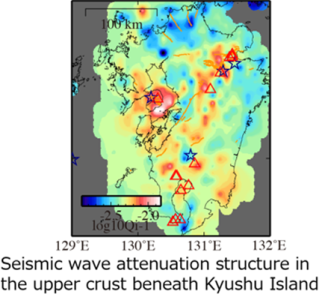
The radius of Earth is 6371 km, whereas the deepest borehole ever drilled reached only 12 km (0.2% of Earth radius) into Earth. It can be said that Earth’s deep interior is the place further than the universe. We analyze the seismic wave and explore the deep interior of the earth which can’t be seen directly. By analyzing propagation of the seismic wave, we investigate the temperature and the existence of magma and/or fluid, and we consider the dynamics of the Earth.
- Desired cooperation
-
- Seismic structure of the incoming oceanic plate and subduction zone earthquake
- Deep structure of the active volcano
-
Faculty of Management, Department of Management
- Professor
- Hideo MORIMOTO
- Research Field
Tourism Marketing and Tourism Studies
- Keyword(s)
Tourism-based urban development, destination-based tourism, regional management
- Research theme
-
- Research on regional revitalization through tourism in local cities facing simultaneous population decline and globalization.
- Diversifying Tourism and Tourism Marketing
Outline of research activities
1. Regional Revitalization and Community Development through Tourism
Japan is experiencing both population decline and aging, in addition to globalization. “Revitalizing local communities through the expansion of exchange and relationship populations” is becoming a key theme. One answer to this theme is “tourism,” and various promotional measures are being actively implemented throughout Japan. This research focuses on various methods, organizations, and regional initiatives as case studies to harness the power of tourism.
2. Diversifying Tourism and Tourism Marketing
Tourism is shifting from traditional sightseeing to an “authenticity-oriented” approach that emphasizes experiential value. This has led to a diversification of travel forms and customer needs, making it more complex. To address this diversification of tourism, we believe that tourism marketing requires understanding needs through data analysis and a marketing approach that considers both “Tokyo” and “outside Tokyo.” This research is progressing in this area.- Desired cooperation
-
- Community development projects related to local tourism
- Projects aimed at increasing the number of visitors and people with connections to the area.
-
Faculty of Management, Department of Management
- Professor
- Makoto UCHIDA
- Research Field
International Business Management, Video Game Development, Project Management
- Keyword(s)
Entertainment, Video Games, Global Business Management
- Research theme
-
- International Business Management in the IT Industry
- Transition of Video Game Development Tools
- Skills Required for Video Game Developers
Outline of research activities

The world is home to an estimated 11.1 million game developers, and this number continues to grow annually. The skills demanded of these professionals are constantly evolving due to the emergence of new platforms, the diversification of game genres, and the rapid advancement of technology. While some areas require highly specialized knowledge that drives the IT industry, the advent of sophisticated development tools has made it possible for even complete novices to create popular games, and those who utilize these tools can also thrive as accomplished developers. Our laboratory analyzes these shifts in the skills required of video game developers and their future prospects by investigating and analyzing global video game market trends and the progress of digital technology.
Simultaneously, by surveying the current situations and challenges faced by developers both in Japan and abroad, we delve into strategies for sustainable corporate growth in the rapidly changing game industry and the ideal approaches to human resource development within this context.
- Desired cooperation
-
- IT Business Strategies in International Corporations
- Development of Human Resources for Video Game Development
- International Marketing Information on the Digital Game Market
-
Faculty of Management, Department of Management
- Professor
- Takahisa YAMAGUCHI
- Research Field
Financial,Corporate Strategy,Marketing
- Keyword(s)
Customer Relationship Management, Regional Finance
- Research theme
-
- Customers’ Viewpoints Management
- Development of a Next-Generation CRM System
Outline of research activities

CRM was developed by the laboratory of Yamaguchi is integrated in one database each company on another system decentralized information systems. Here, provides accurate customer information gathering, analysis and sharing. In addition, employees are working, you can take advantage of the system are. Plays the role of generating added value as a result, information infrastructure.
From this company is important, rather than in a specific department or human resources to implement CRM, employees share information, leverage and produce value added customer in problem-solving, while proposals to. It is a new concept of companies that cannot deliver value, judging by the value proposed by the companies using customer.
- Desired cooperation
-
- Based on the theory of new marketing next-generation CRM development.
- Theory of customer value co-creation with customers about to start marketing an embodiment.
-
Faculty of Management, Department of Management
- Professor
- Yuichi MORI
- Research Field
Computational Statistics
- Keyword(s)
Statistical computing, Data science, Multivariate methods, Social research
- Research theme
-
- Analysis for mixed measurement level data
- Variable selection in multivariate methods without external variables
- Acceleration of statistical computation and its application
Outline of research activities
Let me introduce the second topic of my research interests:
Consider a situation in which we wish to select items or variables so as to delete the redundant variables or to make a small dimensional rating scale to measure latent traits, variable selection in principal component analysis (PCA) is necessary to identify a subset of variables that represents all variables as much as possible.
In the figure below, the left-hand plot is a scatter plot of the 1st and 2nd principal components (PCs) obtained based on all 19 original variables, and the right-hand plot is based on seven selected variables. Little difference exists between the two configurations of PCs. This illustrates the meaningfulness of variable selection in PCA since selected variables can provide almost the same result as the original variables if the goal of the analysis is to observe the configuration of the PCs.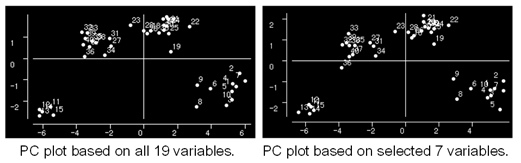
We can perform the variable selection in PCA as a prior analysis in big data analysis, and apply the proposed selection procedures to other multivariate methods such as factor analysis and correspondence analysis.In this topic, we also study on how to deal with categorical/qualitative data (for the first topic), and how to improve the computation effectively (for the third topic).- Desired cooperation
-
- Data analysis
- Social research
- Data science education
-
Faculty of Management, Department of Management
- Associate professor
- Ryohei TAKAHASHI
- Research Field
Rural Development, Social Innovation
- Keyword(s)
Rural management, Rural innovation, Destination Management/Marketing Organization(DMO)
- Research theme
-
- Sustainability of rural development through a destination management organisation.
- Building a rural development marketing database.
- Role of innovators in regional innovation
Outline of research activities
In response to the crisis of social, cultural, and economic sustainability in rural areas caused by declining birthrates and aging populations, the regional management movement, in which industry, academia, government, and the private sector collaborate to solve problems, has attracted attention.
In this laboratory, we support the construction of marketing databases for tourism marketing organizations that practice regional management, while analyzing the information obtained from these databases and examining effective regional management strategies.
There are two topics in this laboratory,
(1) Research on the relationships and roles among entities in effectively functioning regional management,
(2) Research on the construction of a marketing database that contributes to the formulation of regional management strategies and on evaluation indices for regional management.- Desired cooperation
-
- Developing a marketing database for strategic rural management planning
- Analysis of economic ripple effects of events, etc.
-
Faculty of Management, Department of Management
- Associate professor
- Shinji HONGE
- Research Field
Global management, Sales & Marketing Strategy
- Keyword(s)
Value creation, Business transformation, Experiential learning
- Research theme
-
- EIgyo as a value-creating entity
- Eigyo-driven business transformation
- Eigyo person's growth through experiential learning
Outline of research activities
In Japan, Eigyo is often confused with sales and treated as a subordinate concept of marketing. However, in reality, Eigyo in a company plays a broad role in “connecting” the company with its customers, each department within the company, each department within the customer’s company, partner companies, domestic and overseas, and even society. Our research focuses on Eigyo as a process of business transformation and social problem solving, rather than simply selling products and services, and as a value-creating entity.

- Desired cooperation
-
- Development of Eigyo persons capable of creating value
- Creation of new businesses that solve social issues
- International comparison of Eigyo and sales activities, etc.
-
Faculty of Veterinary Medicine, Department of Veterinary Medicine
- Professor
- Akikazu SAKUDO
- Research Field
Food Safety, Virology
- Keyword(s)
Prion, Virus, Disinfection, Sterilization, Gas plasma, Ozone
- Research theme
-
- Non-thermal disinfection technology
- Anti-bacterial and anti-viral reagents and materials
- Novel sterilizers and inactivation mechanisms
Outline of research activities
Novel technologies to efficiently and safely disinfect agricultural products have been studied. We aim to contribute to food safety and security by developing innovative disinfection methods..
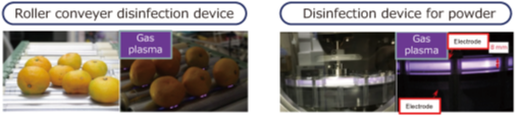
In addition, we have studied the effect of disinfectants against a range of pathogens on different materials, including influenza virus and feline calicivirus (a surrogate of human norovirus) as well as prions (most resistant pathogen). We also analyzed the likely mechanism of pathogen inactivation. Given our focus of research, we would like to collaborate with companies to assist in evaluating products as well as developing new technologies.- Desired cooperation
-
- Development of non-thermal technology in the field of food science
- Evaluation of anti-bacterial and anti-viral effects of products
- Product evaluation of sterilizers
-
Faculty of Veterinary Medicine, Department of Veterinary Medicine
- Professor
- Hiroshi YOKOYAMA
- Research Field
Fish pathology
- Keyword(s)
Fish parasite, Food hygiene, Winemaking
- Research theme
-
- Biology of fish-parasitic myxozoans and microsporidians
- Control measures of myxozoan and microsporidian diseases
- Diagnosis of fish parasites in seafoods
- Evaluation of administering grape pomace, effluent from winemaking, on immunity in cultured fishes
Outline of research activities
We study on the biological characteristics of fish parasites with the aim of disease control. Also, many fish parasites in seafoods have been subject to complaints by comsumers. However, fish parasites normally live in wild environments, and it is crucial to discriminate between harmful and harmless for humans.
To improve the quality of farmed fishes, we try to feed grape pomace, effluent from winemaking, on the immunity and health condition in cultured fishes.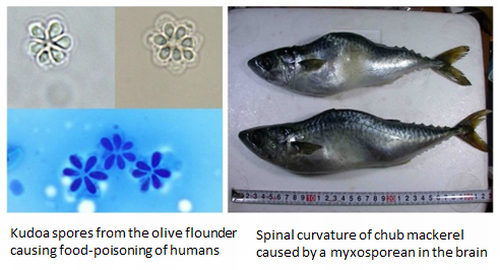
- Desired cooperation
-
- Control measures of parasitic diseases in fish farms
- Diagnosis of fish parasites in seafoods
- Improvement of cultured fishes by feeding grapa pomace
-
Faculty of Veterinary Medicine, Department of Veterinary Medicine
- Professor
- Masumi ETO
- Research Field
Professor of Veterinary Medicine
- Keyword(s)
Physiology, Biochemistry, Molecular Biology
- Research theme
-
- Smooth muscle, artery, digestive tract, cell signaling, CPI-17
- Establishing veterinary medical engineering field
- Coordinating Himepet, a pet-related industrial cluster
Outline of research activities
Smooth muscle cells are major components of the organ walls of organs, such as artery, gastrointestinal tract, bladder and trachea. Smooth muscle cell motility is highly regulated by nerve and hormonal stimuli. Accumulating lines of evidence suggest that impaired smooth muscle motility is involved in a variety of diseases, such as hypertension, digestive dysfunction, asthma, and dysuria. To elucidate the molecular basis of smooth muscle diseases, and to develop their effective diagnostic and therapeutic strategies, we have been studying the mechanisms that regulate smooth muscle motor function. Meanwhile, we have discovered a protein that regulates smooth muscle contractile function and have elucidated the underlying mechanism by which the protein mediates regulation of smooth muscle motility. We now study the signals in smooth muscle disease.
In parallel with our research on smooth muscle disease, we are assisting in the development of devices and products to improve the quality of life of animals, including pets, and their owners through collaborative research.- Desired cooperation
-
- Translational research in organ failures
- R&D in pet-related devices and products
-
Faculty of Veterinary Medicine, Department of Veterinary Medicine
- Professor
- Yasunori SHINOZUKA
- Research Field
Preventive Veterinary Medicine
- Keyword(s)
dairy cattle, mastitis, 16S rRNA
- Research theme
-
- Exploring the possibility of new prevention and treatment of mastitis using milk microbiota
Outline of research activities
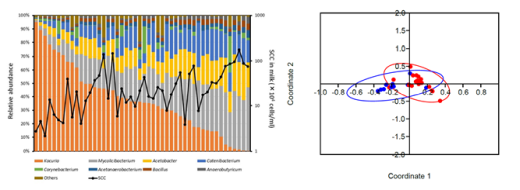
Our laboratory has established a technique to examine the composition of the mammary flora by comprehensively analyzing the bacterial DNA (16S rRNA gene) contained in milk. Using this technology, we clarified that the relationship between SCC and mammary flora composition of healty cows (left figure). It has also become clear that there is a possible relationship between the composition of the mammary flora and the amount of the immune substance (lactoferrin) contained in milk (right figure). We are conducting research not only for the development of new treatments for bovine mastitis, but also for the application of new mastitis prevention methods using intramammary innate immunity.
- Desired cooperation
-
- Accumulation of basic knowledge on milk microbiota
Search by department
Search by SDGs